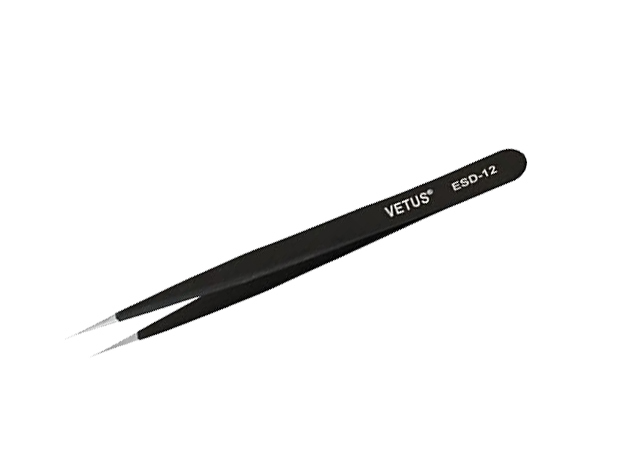
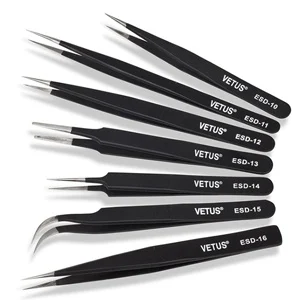
Antistatic Tweezers – Essential Tools in Modern Industry
In the electronics, semiconductor, clean room and biomedical industries, safety and precision in the process of handling components are always put first. Just a small mistake or a seemingly harmless factor such as static charge can cause serious consequences. This is the reason why antistatic tweezers were born and are increasingly becoming a mandatory tool in many modern production and research fields.
Static electricity – Potential danger in micro-manipulation
Static electricity is a natural physical phenomenon that occurs when two materials come into contact and separate, creating an imbalance of electric charge. In daily life, electrostatic discharge often does not cause obvious effects. However, in the electronics and high technology fields, even a small electrostatic discharge can completely destroy a chip, a circuit board or reduce the performance of the device.
When people directly handle components, especially ultra-sensitive semiconductor microcomponents, the risk of transmitting electric charges from hands or non-antistatic tools is very high. Therefore, the use of specialized tools such as antistatic tweezers is an essential solution to minimize risks and protect components in an absolutely safe way.

Structure and operating principle of antistatic tweezers
Antistatic tweezers are made from special materials that can control or disperse electric charges such as: conductive plastic, ESD-coated alloy, insulating ceramic, or carbon fiber. Thanks to that, the tweezers do not conduct or accumulate electricity like conventional metal tweezers, helping to completely minimize the phenomenon of electric sparks during operation.
In addition to antistatic ability, tweezers are also designed with high precision: the tweezers tips are thin, even, sharp and not off-center. This makes it easy for users to pick up, hold and manipulate micro-components without causing physical damage such as scratches, cracks or bent component pins.
Applications in practice
Antistatic tweezers are currently widely used in many fields:
- Electronic components manufacturing industry: Tweezers are used to pick up and assemble SMD, IC, transistor components… in SMT lines or in the process of testing and repairing circuit boards. Using ESD-compliant tweezers helps ensure that there are no errors in the contact stage, avoiding damage to the microcircuit.
- Cleanrooms and dust-controlled environments: In high-level environments such as cleanrooms, antistatic tweezers help maintain cleanliness, without generating static charge or dirt, meeting the strict requirements of the semiconductor, pharmaceutical and optical industries.
- Laboratory and research: With high precision, ESD tweezers are used to handle small specimens, cell fragments or micro-experimental equipment, especially in the molecular biology and biomedical industries.
- Consumer electronics assembly industry: Factories that produce phones, laptops, and smart home appliances also require the use of antistatic tweezers to ensure safety in the product testing and packaging process.
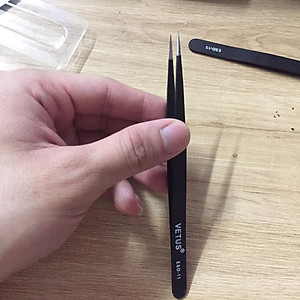
Benefits of using antistatic tweezers
Using antistatic tweezers brings many benefits, not only in terms of technology but also helps to optimize long-term operating costs:
- Protect electronic components from electrostatic damage: This is the core and most important value. An electronic component damaged by ESD is often irreparable and causes great loss.
- Improve accuracy and work efficiency: The tweezers are exquisitely designed to help users operate quickly, accurately, and with less hand fatigue when working continuously.
- Meeting safety standards in modern industrial environments: Modern manufacturing systems require ESD-compliant tools to comply with quality regulations and product security.
- Minimize costs due to damage errors: Using antistatic tweezers helps limit errors caused by operations, reduce repair costs, replace components and avoid rework.
Conclusion
In an increasingly stringent production environment in terms of technical and safety standards, antistatic tweezers are not only a tool to support micro-operations, but also an essential component that contributes to ensuring the quality and reliability of the final product. Choosing the right type of tweezers, meeting ESD standards and suitable for work requirements is important for any unit operating in the high-tech field to pay attention to.
If your business is looking for a solution to improve production efficiency and ensure ESD safety, antistatic tweezers are a small investment with great value.